
Legacy in Graphite: When A Quiet Passion Ignites
FEATURESPEOPLE
A pencil is a quiet thing—light enough to be forgotten in a pocket, ordinary enough to vanish beneath a pile of papers. Yet in the right hand, it can carve light out of darkness, coax softness from sorrow, and breathe movement into stillness. A single stroke can stir sleeping memories, shape unspoken emotions, and summon entire worlds from the hush of a blank page. In the delicate friction of graphite against paper, stories are born—delicate, powerful, and impossible to ignore.
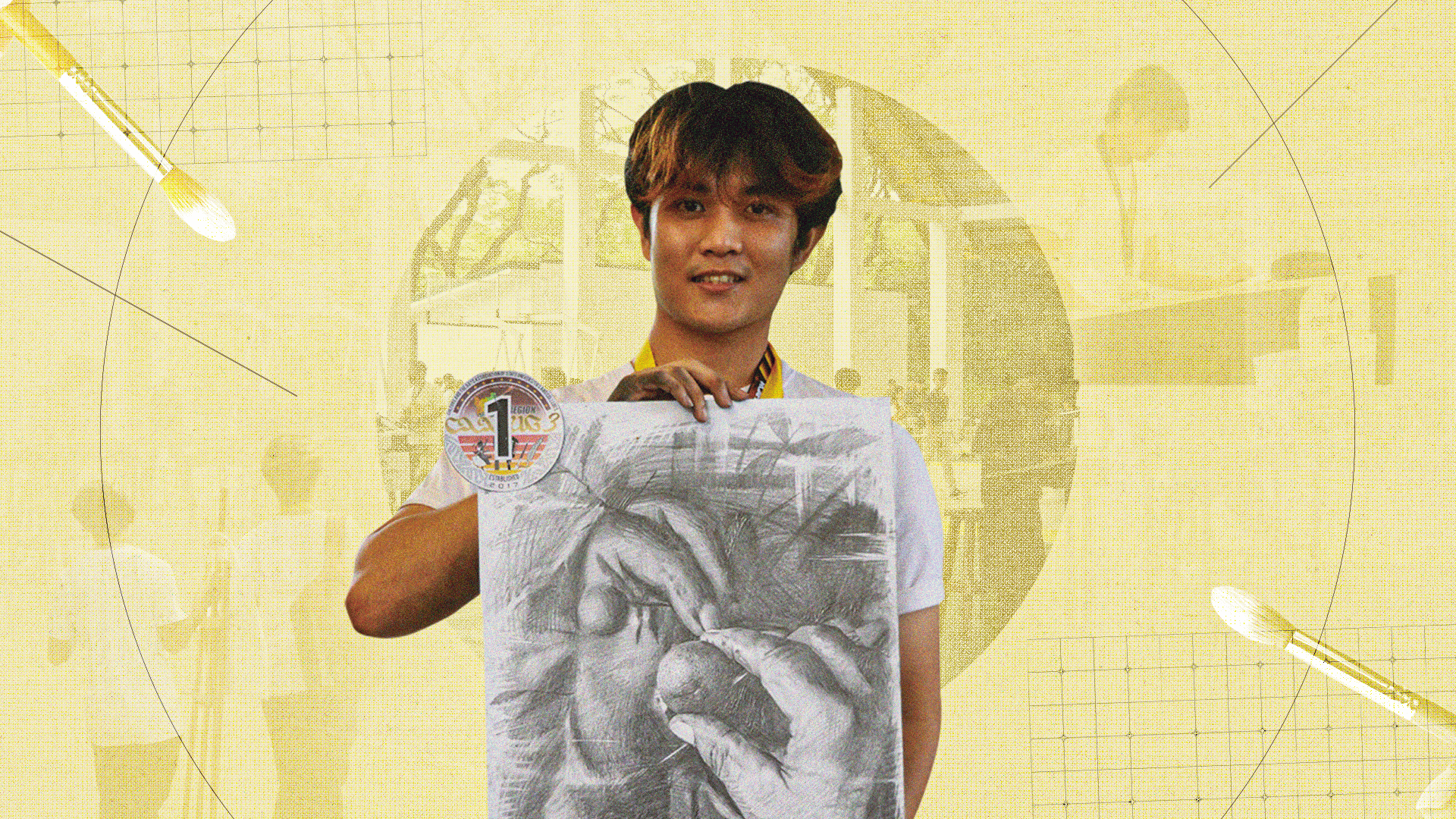
For Emerson Cabaltica, this simple tool has always carried a kind of magic. Long before he understood its pull, the pencil was already shaping him—guiding him through late-night sketches, quiet classrooms, and the private corners where imagination waits. And this year, at the Regional Culture and the Arts Festival (RCAF) 2025, that magic soared. In his first-ever competition, his pencil didn’t merely sketch; it commanded; it spoke boldly—earning him the coveted gold medal and sealing his place among the festival’s most luminous young artists.
First Strokes of Wonder
Long before Emerson became Pampanga State University’s golden artist, he was a child who saw the world differently. While others ran across fields or shouted through school corridors, he slipped into quiet corners, pencil in hand—watching, imagining, turning the ordinary into something extraordinary.
Even in high school, he was drawn to competitions—pencil drawing, journalism, anything that demanded he capture the world in lines and shadows. His notebook margins were never empty, they became a silent record of everything that caught his eye. For him, drawing wasn’t a hobby. It wasn’t a pastime. It was instinct. It was breath.
College sharpened that instinct. The Architecture program at the university taught him more than form and structure—it trained his eyes, forged his discipline, and opened a universe of lines, curves, and symmetry to explore. Originally, he didn’t arrive at the main campus seeking glory. Transferred from Candaba Campus this year, he only wanted a quiet routine—as a 5th-year student, he just wanted to graduate.
But greatness has a way of knocking when you least expect it. The Office of the Culture and the Arts (OCA) offered a chance. When they saw his work, he was invited to represent the university in the pencil drawing category for RCAF 2025—and he accepted wholeheartedly.
“Bago po ako maka graduate, kung papalarin, sayang naman po kung hindi ko i-tatry sumali bago magpaalam sa PSU. Another reason po is gusto ko po malaman kung hanggang saan na ang knowledge ko pagdating sa drawing,” he said, explaining the motivation behind his decision.
It was as if the familiar whisper of the pencil he had carried all his life said, “You’re ready.” He picked it up. And nothing would ever be the same.
Lines That Led to Triumph
The competition was anything but gentle. Emerson faced an illustration board larger than anything he had ever tackled. The rules were unforgiving: no smudging, no shortcuts, no mistakes. And above it all, the clock ticked with relentless insistence, each second threatening to unravel his focus.
The smallest detail—a single calamansi in the reference photo—became his fiercest opponent. The seeds, the dimples on the rind, the translucent pulp catching imagined light; every nuance demanded attention. He poured precious minutes into it, refusing to compromise precision. Every line, every shadow, and every highlight was a test of patience and discipline.
As he drew, tension pulsed through his fingertips. Time slowed and rushed all at once, until the final stroke met the page. All he could do was hope. Hope, but not presume. He stood among giants—seasoned, talented competitors who could have easily claimed the prize. Half of him believed, half doubted.
“Kinabahan po ako ng sobra dahil alam ko po na may mga architecture students din po akong makakalaban. 50/50 [ang pakiramdam], magagaling din po kasi ang kalaban, so depende sa preference ng judge,” he admitted.
Then came the moment of reckoning. When his name was called as the gold medalist, the world seemed to sharpen into focus.
“Nung una po wala po akong confidence kasi parang lahat po kasi magaling, tapos bigla nalang pong natawag ‘yung pangalan ko sa taas,” he recalled, still trembling from the shock and excitement.
On that day, every line he had drawn, every painstaking detail, every trembling moment of doubt, merged into triumph. The sketch he had labored over had become more than art—it had become victory.
Sketching His Own Destiny
After winning the gold medal at the RCAF 2025, Emerson found himself thrust into the spotlight, yet the story behind his success ran far deeper than a single triumph. He made headlines as a first-timer bound for the nationals, but his victory wasn’t the product of just four months of training or the nearly four hours poured into a single drawing. The real secret behind his growth wasn’t talent alone—it was practice. Tireless, relentless, uncompromising practice.
He used to sketch five to ten drawings a day, filling page after page as if watering seeds he hoped would one day bloom. His hands bore the dark stain of graphite. His pencils dwindled to stubs—silent witnesses to countless hours spent shaping the artist he was becoming.
His award wasn't forged in a single morning. It was years in the making—years of broken pencils, sharpened tips, and the quiet whisper of graphite touching paper. The pencil he held on competition day was only one among many, each carrying the weight of dreams long before they had a name.
In the end, Emerson Cabaltica’s story is not just about a competition or a medal. It’s about the quiet, steadfast power of small beginnings—about a boy who picked up a pencil and, unknowingly, picked up his destiny. His journey reminds us that greatness doesn’t always shout. Sometimes, it whispers—through unfinished sketches, late-night practice, and shavings curled at the foot of a sharpener.
What he wants young artists to take from his story is simple: contrary to the popular saying, practice doesn’t make perfect—it makes better.
“Practice makes better. I know maraming artist ang pressured at tinatamad gumawa. [Ang] masasabi ko as an artist din, enjoy niyo lang ang drawing, paglaruin niyo lang ginagawa niyo in a good way. Lastly, always [be] humble sana, wag lumaki ang ulo dahil sa mga achievements or titles, and learning laging nanggagaling sa pagiging student at sa curiosity, hindi sa pagmamataas,” he said, offering advice shaped by years of quiet dedication.
As he prepares for the national stage in Cebu, representing not just the university but all of Central Luzon, he carries with him the same pencil that has always been there—steady, simple, and full of promise.
Because a pencil, in the right hand, doesn’t just draw lines. It draws futures. And Emerson is only beginning to sketch his.